Did Claude prove the Riemann hypothesis? The claim, the checks and what it means
On November 20, 2026, Levent Alpöge, a mathematician at Anthropic, said he had proved the Riemann hypothesis working with Claude, Anthropic's AI model. The hypothesis has been open since 1859 and carries a $1 million prize. The proof is computer code. It passes every computer check run on it so far, but no expert or institution has confirmed it yet.
This article covers what the hypothesis says, what was claimed, what has and hasn't been checked, and what it means outside math. It will be updated as the checks finish.
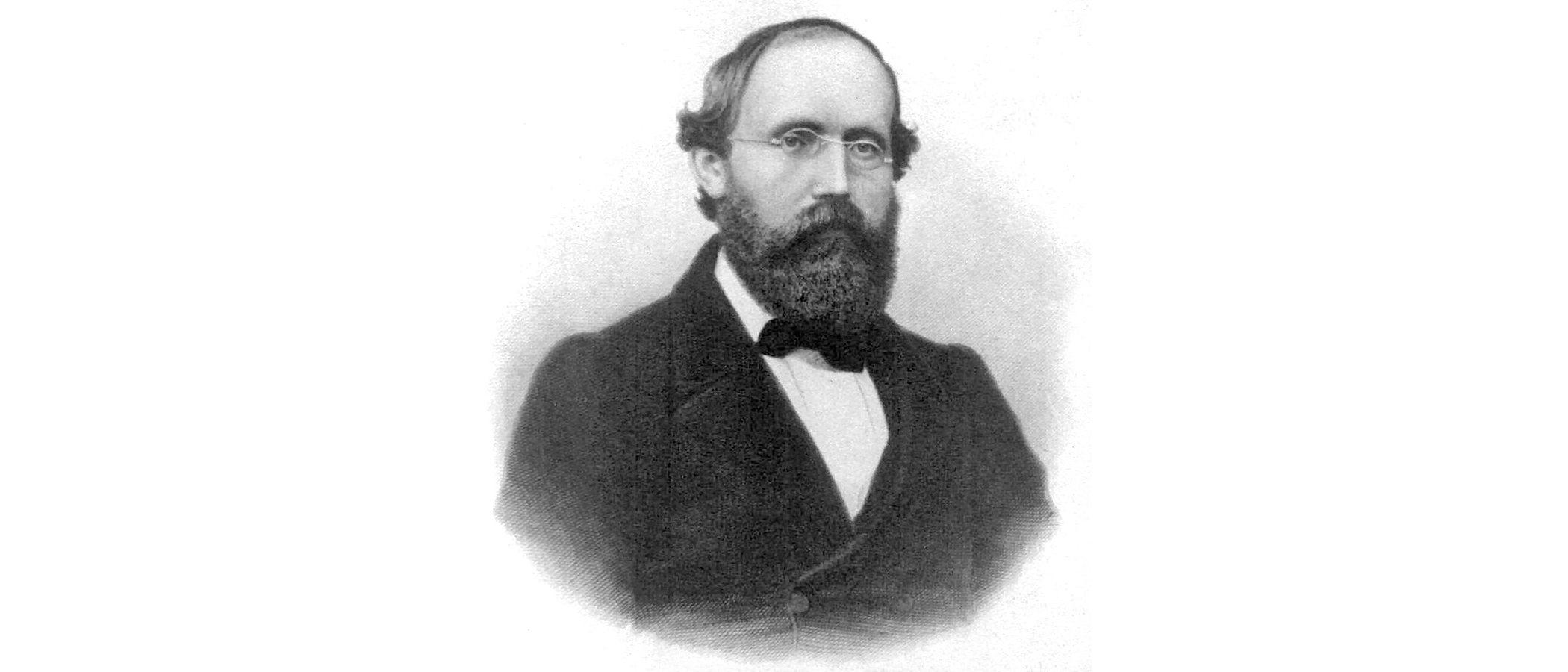
- Year Bernhard Riemann wrote it down
- 1859
- Clay Mathematics Institute prize for a proof
- $1M
- Zeros checked by computer, all on the line
- 10T
- Lean files in the claimed proof
- 175,187
- Pages if the proof were written by hand
- 250K+
- Errors when MIT compiled the code
- 0
What happened on November 20?
Alpöge posted a four-page note on his website. In it he wrote: "I believe I have, working with Claude, discovered a proof of the Riemann Hypothesis." He says the same method also proves the Generalized Riemann Hypothesis for Dirichlet L-functions, a wider family of the same problem.
He did not post a paper. He posted the proof as 175,187 files of Lean code, a language in which a computer checks every logical step. Written out by hand, the proof would run past 250,000 pages, according to Alpöge's note and University of Manchester mathematician Thomas Bloom.
According to his note, the work started on October 6, 2026, and the last pieces came together late on Sunday, November 15. That is about six weeks. He wrote that he had expected the problem to take decades.
Scientific American broke the story the same day. Within hours MIT mathematician Andrew Sutherland had compiled the full proof himself. He called it "an historic moment" and added that much work remains to understand the mathematical details.
What is the Riemann hypothesis, in simple terms?
It is a statement about prime numbers: 2, 3, 5, 7, 11 and every other whole number that can only be divided by 1 and itself.
Primes get rarer as numbers grow, but not smoothly. There are 168 primes below 1,000 and only 112 between 9,000 and 10,000, and the count jumps up and down along the way.
- 1681–1,000
- 1351,001–2,000
- 1272,001–3,000
- 1203,001–4,000
- 1194,001–5,000
- 1145,001–6,000
- 1176,001–7,000
- 1077,001–8,000
- 1108,001–9,000
- 1129,001–10,000
Counted by Vault. 1,229 primes in all below 10,000.
In 1859, the German mathematician Bernhard Riemann found that the positions of the primes are controlled by one function, now called the Riemann zeta function, ζ(s). The places where that function equals zero act like the notes in a chord: together they produce the exact count of primes.
Some zeros are easy to find: −2, −4, −6 and so on. These are called the trivial zeros. All the others sit in a narrow band. Riemann guessed that every one of those others lies on a single straight line, where the real part of s equals 1/2. The first three are at heights of about 14.13, 21.02 and 25.01 on that line.
That guess is the Riemann hypothesis. If it is true, the primes are as evenly spread as they possibly could be, and mathematicians can say exactly how far the real number of primes can drift from the estimate.
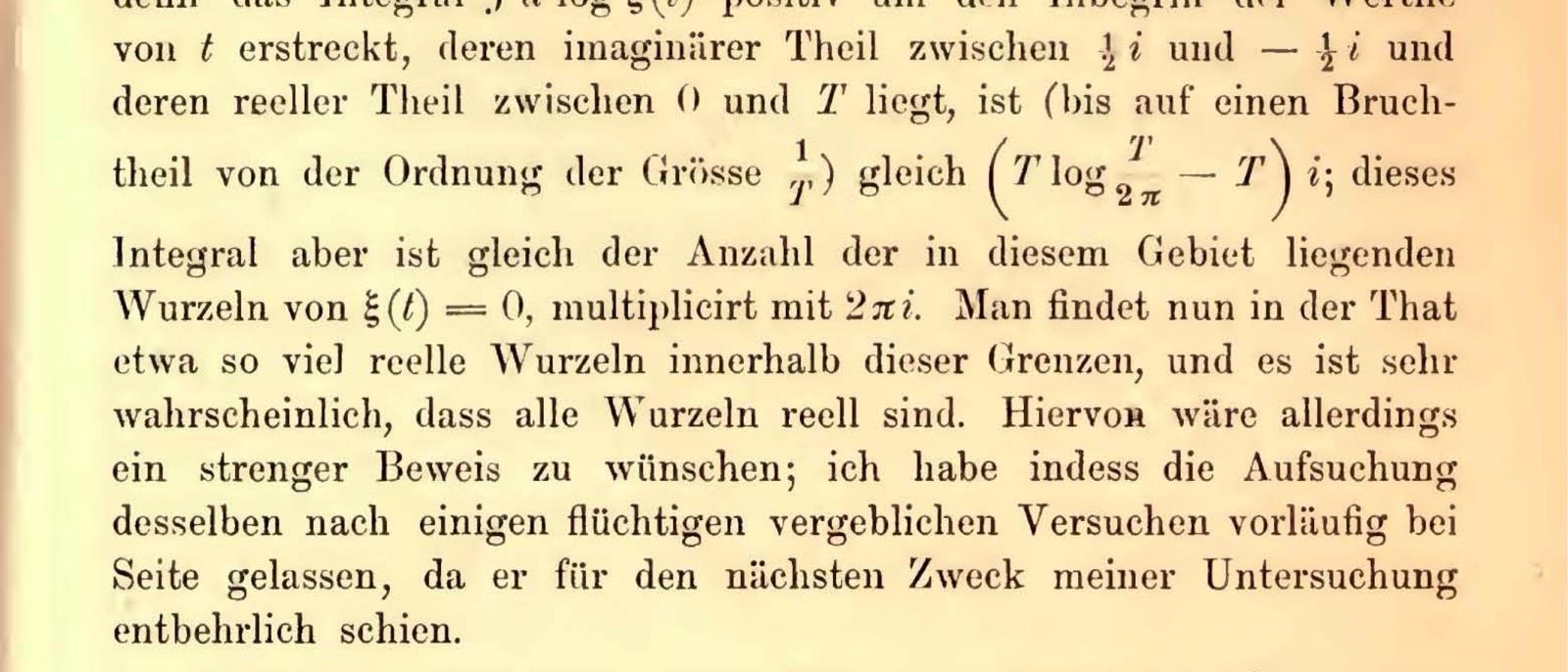
Riemann wrote that it was "very probable" all the zeros fit, and that he had set aside the search for a proof after a few brief, failed attempts.
Why was it so hard to prove?
Because checking examples is not proof. Computers have confirmed that the first 10 trillion zeros sit on the line, but there are infinitely many, and one exception anywhere would make the hypothesis false.
| Year | Who | Zeros checked on the line |
|---|---|---|
| 1903 | Jørgen Gram | 15 |
| 1936 | Edward Titchmarsh | 1,041 |
| 1953 | Alan Turing | 1,104 |
| 1986 | Jan van de Lune and others | 1.5 billion |
| 2004 | Xavier Gourdon | 10 trillion |
David Hilbert put it on his list of the 23 great problems of mathematics in
- In 2000 the Clay Mathematics Institute made it one of its seven
Millennium Prize Problems, each worth $1 million.
| Millennium Prize Problem | Status |
|---|---|
| Riemann hypothesis | Claimed proof, November 2026, under review |
| Poincaré conjecture | Solved by Grigori Perelman in 2003. He declined the prize |
| P versus NP | Open |
| Navier–Stokes equations | Open |
| Yang–Mills existence and mass gap | Open |
| Hodge conjecture | Open |
| Birch and Swinnerton-Dyer conjecture | Open |
What role did Claude play?
Alpöge says he found the proof "working with Claude." Reporting on his note says Claude did much of the technical work near the end, including the algebra and supporting lemmas, in an area where Alpöge says he has little expertise of his own.
This is not the first time. Scientific American reports that in July 2026 Alpöge posted a Claude-generated solution to the Jacobian conjecture, another long-open problem.
The choice to post only Lean code is part of the story. Alpöge argued that an AI-written paper nobody could read would be worse than code a computer can check. Some mathematicians disagree. In Nature, Andrew Granville of the University of Montreal called the release "garbled" and said a clear human write-up should have come first.
Has the proof been verified?
By computers, largely yes. By mathematicians, not yet.
Andrew Sutherland at MIT is running every available check and publishing the results. As of 12:55 PM UTC on November 21:
| Check | Result |
|---|---|
| All 175,187 files compile (Lean 4.33.1, Mathlib 4.33.1) | Pass, zero errors |
| The five main theorems use only Lean's three standard axioms | Pass |
| Lean's own kernel replays every file | Pass, 175,187 of 175,187 |
| nanoda, an independently written checker | Accepts |
| con-leche, another independent checker | Accepts |
| The proved theorems match the official challenge statement | Match |
| lean4lean, a third checker | Pass, 175,187 of 175,187 |
| Lean's default and "paranoid" kernels on the full export | Still running |
Two things matter in that table.
- The logic holds. Several separately written programs agree that every step follows from the one before.
- It proves the right thing. The main theorem uses Mathlib's own definition of the Riemann hypothesis, written long before this claim, not a definition Alpöge wrote. That was the biggest early worry.
What computers can't settle is whether mathematicians accept it. That takes people reading and understanding the argument, peer review, and time. No mathematical society, journal or the Clay Mathematics Institute has said the hypothesis is proven.
Was there a second Riemann proof the same day?
Yes, and it has already run into trouble.
On the same day, Stanford mathematician Ravi Vakil, president of the American Mathematical Society, posted a proposed proof of the Generalized Riemann Hypothesis by Alessandro Masullo, a young Stanford mathematician. Vakil wrote that it was "all human, with no AI," and that Stanford's Brian Conrad had been checking it for months.
About eight hours later Vakil added that several people had reported problems in it, found with the help of AI models. He wrote that he makes no claim about whether its strategy is correct. Conrad told Scientific American the proof is "undergoing major revision."
What changes if the proof holds?
Thousands of published results begin with "Assuming the Riemann hypothesis." If the proof holds, they all become proven at once. A few examples:
- How many primes there are. The error in the best estimate of the prime count is pinned down to roughly the square root of the number, a result of Helge von Koch from 1901.
- Gaps between primes. Harald Cramér showed in 1920 that the hypothesis limits how far apart two neighbouring primes can be.
- Primitive roots. Christopher Hooley showed in 1967 that the generalized hypothesis proves Artin's conjecture about which numbers generate all remainders.
- Testing whether a number is prime. Gary Miller's 1976 primality test becomes fully proven. A different test, found in 2002, already does this without the hypothesis.
Beyond math, the bigger news may be who found it. A widely accepted proof would be the first time an AI system played a central part in solving one of the Millennium Prize Problems.
Does it put bank encryption at risk?
No. Scientific American reports that the proof won't upend global banking or make the internet run faster.
Encryption such as RSA works because multiplying two large primes is easy, while splitting the result back into those primes is extremely hard. The Riemann hypothesis is about how primes are spread out. It gives no known shortcut for splitting a number into its primes, so it does not weaken RSA.
What did Anthropic's stock do?
Anthropic listed on Nasdaq as ANT on November 19, 2026, after the largest IPO on record at $83 a share. The proof news came on its second day of trading.
- $83.00IPO price
- $111.50Nov 19 open
- $97.17Nov 19 close
- $89.86Nov 20 open
- $88.91Nov 20 close
Source: Yahoo Finance daily prices, read November 21, 2026.
ANT closed at $88.91 on November 20, down 8.5%, after a low of $83.05. It opened lower, at $89.86, and the whole market fell that day too: the S&P 500 dropped 3.7% and Nvidia 10.9%.
Nothing shows the proof news moved ANT either way. The moment to watch is the verdict from mathematicians, whenever it comes. Our Anthropic IPO guide covers the deal, the owners and the lock-up dates.
Where can I follow it?
Vault is an iPhone app that tracks your Stocks, Crypto and Metals in one place. Add Anthropic and you see its price and its latest news on one page, next to everything else you own, and Ask Vault tells you how much of your money rides on it.

Timeline
| Date | What happened |
|---|---|
| November 1859 | Riemann publishes his paper on the count of primes |
| 1900 | Hilbert lists the hypothesis among 23 great problems |
| 2000 | Clay Mathematics Institute offers $1 million for a proof |
| 2004 | 10 trillion zeros confirmed on the line by computer |
| July 2026 | Alpöge posts a Claude-generated solution to the Jacobian conjecture |
| Oct 6, 2026 | Alpöge's work on the hypothesis begins, per his note |
| Nov 15, 2026 | The last pieces of the proof come together, per his note |
| Nov 19, 2026 | Anthropic starts trading on Nasdaq as ANT |
| Nov 20, 2026 | Alpöge posts the claim and the Lean proof |
| Nov 20, 2026 | Vakil posts Masullo's human proof; problems reported within hours |
| Nov 21, 2026 | MIT reports zero errors and passes from three independent checkers |
Sources
- Levent Alpöge, "Remark", November 20, 2026: the claim, the Generalized Riemann Hypothesis, the timeline and page count.
- Andrew Sutherland, MIT, verification files for the Lean proof, last updated 12:55 PM UTC, November 21, 2026: compile results, axioms, kernel and checker results, the five theorem statements.
- Joseph Howlett, Scientific American, November 20, 2026: the claim, Sutherland's comments, banking, the Jacobian conjecture.
- Joseph Howlett, Scientific American, November 20, 2026: the Masullo proof and Brian Conrad's comments.
- Lee Billings, Scientific American, November 20, 2026: what a proof means for encryption.
- Nature, November 2026: Andrew Granville's comments.
- Ravi Vakil, Math 216 blog, November 20, 2026: the Masullo announcement and its update.
- OfficeChai, November 20, 2026: Thomas Bloom's page estimate and other reactions.
- Bernhard Riemann, "Ueber die Anzahl der Primzahlen unter einer gegebenen Grösse", Monatsberichte der Berliner Akademie, November 1859.
- Clay Mathematics Institute, Millennium Prize Problems and its rules for the prize.
- Xavier Gourdon, "The 10^13 first zeros of the Riemann Zeta function, and zeros computation at very large height", 2004.
- Yahoo Finance, ANT historical prices, read November 21, 2026.
This article was drafted with Claude, an AI model made by Anthropic, the company whose mathematician made the claim. It was reviewed by Vault. Not financial advice.
Questions, answered.
Has the Riemann hypothesis been proven?
Not officially. On November 20, 2026, Anthropic mathematician Levent Alpöge posted a claimed proof, made with Claude and written in the Lean proof language. MIT's Andrew Sutherland reports that it compiles with zero errors and passes several independent checkers, but no mathematical body has accepted it yet.
What is the Riemann hypothesis in simple terms?
It says the prime numbers, which look scattered at random, follow a precise hidden pattern. Technically, it says every non-trivial zero of the Riemann zeta function has real part 1/2, so they all sit on one straight line.
Who is Levent Alpöge?
A mathematician who works at Anthropic, the company that makes Claude. He posted the claim on his website on November 20, 2026, saying he found the proof working with Claude.
Did AI solve the Riemann hypothesis?
Alpöge says he found the proof working with Claude, and that Claude did much of the technical work near the end. The proof itself is computer code that a program checks step by step. Whether it is accepted is still up to mathematicians.
Who gets the $1 million Millennium Prize?
Nobody yet. The Clay Mathematics Institute's rules require a proof to be published in a qualifying outlet, at least two years to pass, and general acceptance by mathematicians before it considers a prize.
Does proving the Riemann hypothesis break encryption or banking?
No. Scientific American reports it won't upend global banking. Bank encryption such as RSA depends on how hard it is to factor large numbers, and the Riemann hypothesis gives no known shortcut for that.
What is Lean?
A programming language and proof checker. Every step of a proof written in Lean is checked by a small program called a kernel, so a proof that compiles has no logical gaps, as long as its starting definitions say what they are meant to.
What did Anthropic stock do after the Riemann news?
ANT closed at $88.91 on November 20, 2026, down 8.5% on its second day of trading and above its $83 IPO price. The whole market fell that day: the S&P 500 dropped 3.7%. Nothing shows the proof news moved the stock.
Your Stocks, Crypto and Metals in one place.
Vault for iPhone. Free 7-day trial.